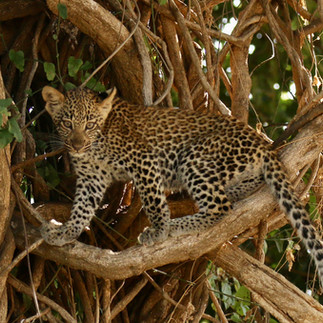
Zambia's Leopards
Is the Kafue emerging as one of Africa's great leopard strongholds?
For decades, Zambia's South Luangwa and Lower Zambezi national parks have been celebrated for their leopards. But research in Kafue National Park is revealing something remarkable: leopard populations in parts of this vast wilderness are considerably higher than previously recognised, with densities comparable to some of Africa's most celebrated leopard habitats.
Research by Musekese Conservation is changing perceptions of Zambia's leopard populations and revealing why certain areas support exceptional numbers of these normally elusive cats.
An unexpected concentration of leopards
In 2024, camera-trap research by Musekese Conservation identified 95 individual leopards in the surveyed areas of the Musekese–Lumbeya region of Kafue National Park.
Even more striking were the densities recorded.
Researchers estimated approximately nine leopards per 100 square kilometres in parts of the study area, placing Musekese among the highest-density leopard habitats documented in Southern Africa.
These figures are comparable to those recorded in South Africa's renowned Sabi Sands, internationally recognised for its exceptional leopard population.
Chisomo M'hango, a field ecologist with Musekese Conservation, discussed the findings in a July 2025 interview with Mongabay.
Camera-trap monitoring began in 2022 to establish population estimates and investigate the conditions supporting the species. The 95 individuals identified in 2024 represented only the surveyed areas, not the entire Musekese–Lumbeya landscape.
M'hango also reported that leopard densities in some parts of Kafue had nearly tripled compared with initial estimates, with improved law enforcement considered a likely contributing factor.
How does Kafue compare with South Luangwa?
South Luangwa has long been regarded as one of Africa's leading leopard habitats, a reputation supported by scientific research.
Earlier studies recorded approximately 8.2 leopards per 100 square kilometres in one surveyed area of South Luangwa, while other research in the Luangwa Valley recorded 8.5 per 100 square kilometres.
At approximately nine leopards per 100 square kilometres in its highest-density surveyed areas, Musekese is recording numbers comparable to, and sometimes exceeding, those documented in parts of South Luangwa.
Although these studies were conducted at different times and locations, the findings demonstrate that Kafue deserves recognition alongside Zambia's established leopard strongholds.
Are the leopards becoming easier to see?
One of the most interesting aspects of the Musekese findings is that the scientific evidence is increasingly reflected in observations on the ground.
Leopards are generally solitary and secretive, but individuals regularly encountering non-threatening vehicles can become accustomed to their presence, allowing prolonged observations of natural behaviour.
At Musekese, a substantial resident population, established guiding routes and increasing familiarity with vehicles have contributed to exceptional leopard encounters.
In a March 2025 interview, Tyrone McKeith of Classic Zambia described Musekese as an area with:
“incredible predator sightings (one of the highest densities of leopard in Africa)”
There is also evidence of improving wildlife sightings. A June 2025 Zambia Tourism report, drawing on Musekese Conservation's research, recorded an increase in reported cat sightings by game-drive parties from 175 to 250 by 2024.
Although this figure includes cats other than leopards, it provides further evidence of improving predator encounters alongside the conservation research.
Why are leopard numbers so high?
The explanation appears to involve suitable habitat, abundant prey and effective protection.
The Musekese–Lumbeya landscape combines extensive woodland, riverine vegetation and populations of small and medium-sized antelope, providing both cover and food for leopards.

M'hango identified suitable habitat and prey availability, particularly near the river, as important factors behind the recorded densities. Improved law enforcement is also considered a likely contributor to increasing populations.
Musekese Conservation's 2023–24 research programme employed 200 camera traps across 100 locations, covering approximately 1,044 square kilometres.
Leopard occupancy in the western study area increased from 82% in 2022 to 92% in 2023 and 2024.
Occupancy measures the proportion of surveyed sites where leopards are estimated to occur, rather than individual animal numbers, but the increase represents another encouraging result.
A remarkable conservation story
The significance of these findings extends beyond leopard numbers.
Musekese Conservation was established by Phil Jeffery and Tyrone McKeith, whose development of safari operations in this previously little-visited part of Kafue has been closely connected with wildlife protection and research.
Today, Musekese Conservation operates independently, undertaking wildlife research, law enforcement and community initiatives across the wider Kafue landscape while maintaining close ties with Classic Zambia.
The leopard research forms part of a broader programme examining predator populations, prey availability and conservation effectiveness.
It demonstrates how sustained wildlife protection can produce measurable results.
Reconsidering Zambia's leopard strongholds
South Luangwa and the Lower Zambezi remain outstanding leopard habitats, but research from Musekese–Lumbeya is adding another dimension to Zambia's leopard story.
The figures are compelling: 95 individually identified leopards, local densities reaching approximately nine animals per 100 square kilometres, and evidence of substantial increases in parts of the monitored population.
These findings apply to specific surveyed areas rather than the whole of Kafue National Park. Nevertheless, they demonstrate that some of its habitats support exceptionally high leopard concentrations.
Importantly, these populations are not simply numbers recorded by remote cameras. Their presence is increasingly reflected in the frequency and quality of encounters reported from the area.
For a national park historically receiving relatively little recognition for its leopards, this represents a significant change in understanding.
Kafue's leopards may not be a new phenomenon. What is changing is our understanding of just how many are there.
Research references: Musekese Conservation's 2023–24 monitoring results; Mongabay's July 2025 interview with Chisomo M'hango; published leopard-density research from the Luangwa Valley; and the March 2025 interview with Tyrone McKeith of Classic Zambia.