

Gorillas, forest elephants, time with the Ba'Aka — and a few wet socks. Two ways into the Congo Basin, and a choice we're not making any easier.
I've spent quite a bit of time exploring the forests of Central Africa, particularly around Sangha in the Central African Republic, and more recently Odzala in the Republic of Congo. They're both fascinating places, with plenty in common, but having experienced them firsthand, I've found the differences between them just as interesting as the similarities. And those differences aren't necessarily about the wildlife, but more about how you spend your time exploring these remarkable forests.
Both areas have western lowland gorillas, forest elephants and an extraordinary variety of birds and mammals, as well as some very interesting conservation work. But while the wildlife has much in common, the experiences are quite different, and I thought it would be interesting to share a few observations from my time in both.
Odzala. Three camps and quite a bit of variety
The Odzala journey works around three camps, each giving access to a different habitat. I enjoyed this arrangement, partly because it allowed us to explore a broad cross-section of the rainforest ecosystem without spending endless hours travelling between locations.
Ngaga Lodge is situated in the Ndzehi forest concession adjoining Odzala-Kokoua National Park. The main attraction here is western lowland gorilla tracking, with specialist trackers following groups that have been studied and habituated over many years. The forest is dense, and watching gorillas here can involve a fair amount of patience. You may hear movement or feeding activity before you see the animals, and sometimes the gorillas are high in the trees rather than conveniently positioned in front of you.
At Mboko Lodge, the surroundings are quite different. Here the forest gives way to open grasslands, with rivers and waterways winding through the landscape. There are forest buffalo, antelope, monkeys and other wildlife associated with both woodland and open country. I enjoyed being able to explore the different habitats, particularly along the river, where travelling by boat or kayak gives you access to areas that would otherwise be difficult to reach.
Then there's Lango Lodge, which was a particular favourite of mine.
Lango. Wet socks and a few surprises
Getting to Lango involves a combination of kayaking and walking through water, sometimes considerably deeper than your ankles. If you're particularly attached to dry socks, this might take some getting used to.
I enjoyed it enormously. It's an interesting way to explore, moving slowly enough to notice tracks, feeding signs and the smaller things happening around you. Much of the walking is through flooded forest and along waterways used by elephants and other animals, so there's plenty to occupy your attention.
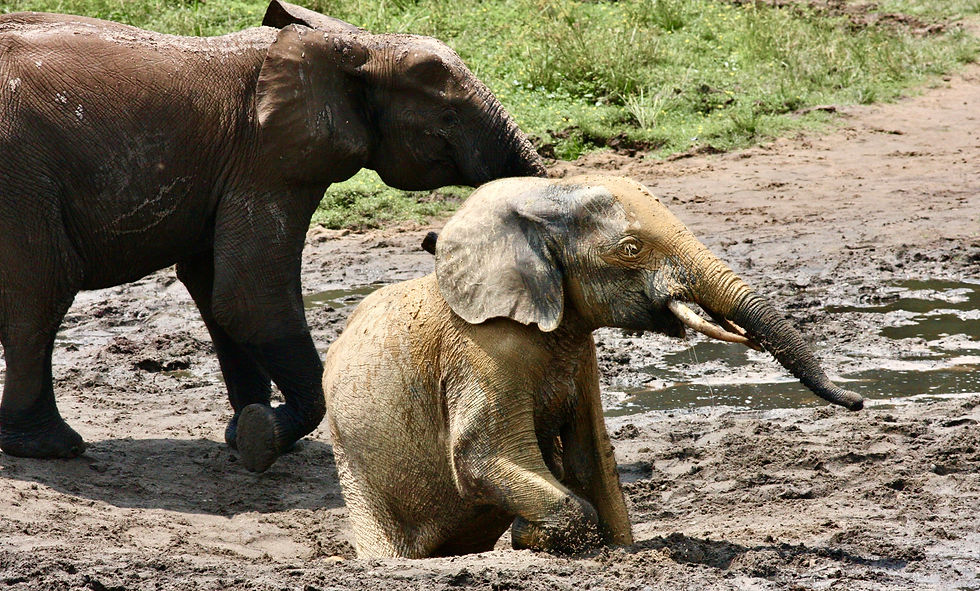
Lango overlooks a bai, one of the natural clearings within the forest where mineral-rich soils and water attract wildlife. Forest elephants and buffalo visit, along with African grey parrots, green pigeons and various other birds. The rooms and communal deck overlook the clearing, so you can continue watching even after you've finished exploring for the day.
During our visit, there was infrared viewing equipment on the deck that allowed us to see what was happening out on the bai after dark. This was particularly interesting during dinner, when the equipment revealed something I hadn't expected to see in this forest environment.
Spotted hyenas.
Now, I've seen plenty of hyenas over the years, but finding them here was something rather different. Recent research has confirmed that spotted hyenas maintain resident populations within Odzala's rainforest, with the bais providing important open areas where prey animals congregate. Lango is one of the locations where researchers have recorded particularly high levels of activity.
It's another example of how much remains to be understood about the animals living in these forests.
The comfortable side of getting thoroughly wet
One thing Odzala does particularly well is accommodation. The camps are extremely comfortable, with excellent food, hospitality and facilities. Given how remote they are, it's impressive how well everything works.
The operators also have a dedicated aircraft service connecting Brazzaville with the Mboko airstrip, which makes the logistics of getting into and out of Odzala considerably easier. Transfers between the camps are organised as part of the journey.
But I wouldn't confuse the standard of accommodation with the nature of the activities. You do need to enjoy walking, and quite a lot of it can be through water, mud and uneven forest tracks. There are also plenty of opportunities to explore by kayak and boat.
Personally, I think the contrast works rather well. You can spend much of the day thoroughly immersed in the forest, sometimes literally, and return to a very comfortable room, a hot shower and a good dinner.
The gorillas, and the people who know them
Western lowland gorillas are an important part of both Odzala and Sangha, and I've always been particularly interested in the research and habituation work that makes these encounters possible.
At Ngaga, trackers lead you into the forest to locate habituated groups. These gorillas live in dense vegetation and spend considerable time feeding both on the ground and in the trees, so sightings can require patience. It's interesting watching their behaviour, particularly once you begin to distinguish the individuals and understand something of the group's activity.
Sangha has its own long-established programme. The Dzanga-Sangha Primate Habituation Programme began in 1997 and has contributed considerably to our understanding of western lowland gorillas. The involvement of Ba'Aka trackers is fundamental to this work, drawing on their extraordinary knowledge of the forest and its wildlife.
Habituation takes years, and the research teams have to balance the value of studying these animals with the need to minimise disturbance. It's worth remembering that when you're watching a habituated gorilla group, you're benefiting from a great deal of patient conservation work. The particular groups available to visitors can change according to the research and management arrangements.
I find both programmes fascinating, and although the forest conditions and tracking experiences differ, I wouldn't suggest one is inherently better than the other.
Sangha. A different way of spending your time
Sangha is somewhere I've enjoyed returning to over the years, and the experience is rather different from moving between the Odzala camps.
Sangha Lodge sits beside the Sangha River in the Central African Republic. Rod and Tam Cassidy have been involved with the area for many years, developing close relationships with local communities and conservation organisations, and that familiarity adds considerably to the experience.
The lodge is comfortable, although without the more elaborate facilities of the Odzala camps. Personally, I like its relaxed atmosphere and the fact that you can spend time exploring without feeling that you're constantly following a programme.
A week is generally the standard stay at Sangha, largely because of the flight arrangements used to reach the area. Unless you're arriving or departing by river, which opens up other possibilities, the logistics tend to determine the length of your visit.
Fortunately, there's more than enough to occupy a week. Dzanga Bai, forest walks, river exploration, gorilla tracking and time with the Ba'Aka community can all be part of the experience. And if you have particular interests in birds, mammals or the conservation work taking place in the area, there's plenty of scope to spend more time on those.
One of the things I enjoy about Sangha is getting to know the people involved in the different activities. Their knowledge of the forest, its wildlife and the work being done to protect it adds a great deal to your understanding of the place.
Dzanga Bai. Still one of my favourite places
I don't think I could write about Sangha without spending some time on Dzanga Bai.
For anyone unfamiliar with the term, a bai is a natural clearing in the forest, often containing mineral-rich soils and water that attract animals from the surrounding rainforest.
Dzanga is particularly well known for its forest elephants, although plenty of other wildlife visits too.
The walk through the forest is part of the experience. You can hear hornbills and other forest birds, and early in the morning the African grey parrots can be extraordinarily noisy. As you approach the clearing, you may also begin to hear elephants calling, moving through the vegetation or splashing in the water.
Then you reach the forest edge and suddenly have a view across the bai.
There can be dozens of elephants, sometimes more than a hundred, scattered across the clearing. They're drinking, digging into the mineral-rich soils, feeding and interacting with one another. From the raised observation platform, you can watch behaviour that would be almost impossible to see amongst the trees.
One of the things I find particularly interesting is their social organisation. Forest elephants generally move through the forest in relatively small family units, often a mother and her dependent young. At Dzanga, numerous separate families and individual bulls come together, sometimes giving the impression of one enormous herd.
But they're not one herd at all. Spend some time watching and you begin to recognise the smaller groups, the relationships between animals and the different interactions taking place.
Long-term research, particularly the work of Andrea Turkalo and the Elephant Listening Project, has revealed a great deal about these relationships.
There are also sitatunga, which we regularly see, forest buffalo, and occasionally bongo emerging from the forest. Palm-nut vultures are often around, and the African grey parrots can create quite a racket, particularly in the morning.
I can spend hours here quite happily. There's always something interesting happening, and it's one of those wildlife locations where there's little reason to be in a hurry.
Time with the Ba'Aka
Another reason I enjoy Sangha is the opportunity to spend time with the Ba'Aka people.
Their understanding of the forest is extraordinary, and if you have the opportunity to walk with experienced Ba'Aka guides, you'll quickly appreciate just how much you would otherwise overlook.
Plants have practical or medicinal uses, barely visible signs reveal animal movements, and what might appear to be an indistinct patch of forest to us can be full of information to someone who knows it intimately.
Through the relationships developed around Sangha Lodge, there are opportunities to share aspects of Ba'Aka forest life, including gathering, tracking, traditional net hunting and music.
The music is particularly memorable. Ba'Aka polyphonic singing, with its overlapping voices and complex rhythms, is a remarkable tradition, and one that I find difficult to describe adequately. It's something you really need to hear.
What I've always appreciated about these encounters is the way knowledge and culture can be shared quite naturally. They don't need to feel like organised performances. There's an opportunity for genuine exchange, provided that the community wishes to share these aspects of its life and the encounter is approached with appropriate respect.
I think that relationship with the local people is one of Sangha's particular strengths.
Pangolins and a bird that looks rather improbable
Rod and Tam Cassidy have also been involved in some very interesting conservation work with pangolins, including rescuing, rehabilitating and monitoring white-bellied and black-bellied pangolins.
The work involves local trackers and conservation partners, and some of the animals being monitored have spent time in the forest around the lodge. There may be opportunities to learn about the project and, depending on the animals involved, observe pangolins, although I wouldn't treat that as something to expect on every visit.
For birdwatchers, Sangha also offers the possibility of searching for the red-headed picathartes, or grey-necked rockfowl.
It's an extraordinary-looking bird, with a brightly coloured, largely bare head, long legs and a rather peculiar appearance. Reaching suitable habitat can involve travelling upriver and then walking into the forest towards rocky outcrops and waterfalls.
Finding the bird is another matter. Even where nesting sites are known, it can be elusive, but for anyone with a particular interest in African forest birds, it's certainly worth making the effort.
And there are plenty of other birds and forest wildlife to keep you interested along the way.
Travelling through the Congo by river
There is another way of exploring this part of Central Africa that we have been involved with for some time.
We also arrange river expeditions with Expéditions Ducret, travelling aboard the Princesse Ngalessa, which provides comfortable accommodation while exploring parts of the Congo and Alima river systems.
Some of the longer journeys connect with the Sangha region, combining time aboard the vessel with road transfers and smaller motorboats. The route between Ouesso and Bayanga is particularly interesting, following the Sangha River through forested landscapes and past riverside communities.
The river journey gives you an opportunity to see something of the everyday life of the region. Fishing boats, river transport, settlements and the importance of the waterways to local communities all become part of the experience.
I would be quite candid about wildlife sightings from the boat. Large mammals can be difficult to see, and opportunities for wildlife photography are often relatively limited. It isn't the same experience as spending time at Dzanga Bai or tracking gorillas.
But if you're interested in a broader exploration of the region, particularly the relationship between the forest, the rivers and the people living alongside them, it's an interesting addition.
And, as mentioned earlier, travelling by river can also give you more flexibility over the time you spend around Sangha.
Making it all come together
One thing that has changed considerably over the years is how much easier it has become to organise travel into these parts of Central Africa. I remember when the visa arrangements alone could feel like a small expedition. Thankfully, much of that has improved, and we can now help guests through the visa application process, arrange the necessary supporting paperwork and coordinate the details well before departure. There are still formalities to deal with, of course, and requirements vary between countries, but the process is generally much more manageable than it once was.
Over the years I've developed some very good relationships with the people working in both Odzala and Sangha, and that makes a considerable difference when putting journeys together. I enjoy arranging tailor-made trips around particular interests, whether that's gorillas, forest elephants, birds or some of the smaller, more elusive mammals. Just as importantly, I know the people on the ground who will be looking after our guests throughout their journey. In places like these, having experienced and dependable people handling the arrangements is particularly reassuring.
I also try to put together small-group journeys from time to time, particularly for people who would enjoy sharing the experience with others who have similar interests. I come along on these trips myself, something I thoroughly enjoy. It's always interesting seeing familiar places through other people's eyes, and there's invariably something that surprises me too.
These are still remote parts of Africa, and occasionally things don't go entirely to plan. But that's rather different from suggesting they're difficult places to travel to. Good local knowledge, sensible preparation and the right arrangements can take much of the strain out of the journey.
There is, of course, a separate question of security, particularly in the Central African Republic. Official travel advice, current local conditions and appropriate insurance arrangements need careful attention, irrespective of how experienced the people organising the journey may be.




The cost difference
There is a considerable difference in the cost of these two experiences, and I think it's worth being straightforward about it.
Odzala is generally the more expensive option, particularly if you combine all three camps. The accommodation is of a very high standard, the dedicated aircraft and organised transfers make the logistics relatively straightforward, and you're exploring several different habitats within one journey.
Sangha is generally a more cost-effective way to spend time in the Congo Basin. You don't have the same level of luxury, but you certainly aren't sacrificing anything in terms of getting out into the forest and experiencing its wildlife.
In fact, spending a week based at Sangha Lodge can give you considerable time at ground level, exploring with people who know the area exceptionally well. Dzanga Bai alone is somewhere I could happily spend several days.
There are other factors to consider, including the cost of reaching each destination, group size, permits and the activities involved, so comparisons need to be made on the complete journey rather than accommodation rates alone.
So, which Congo?
Having experienced both, I can see plenty of reasons to enjoy either.
What I liked about Odzala was the opportunity to explore several quite different habitats, moving between camps and spending a good deal of time walking and travelling on the waterways. The accommodation and organisation are excellent, and the variety is appealing.
Sangha remains somewhere I have a particular affection for, largely because of the people, the wildlife and the amount of time you can spend getting to know the place.
The Ba'Aka, the conservation work, the forest around the lodge and, of course, Dzanga Bai all contribute to that experience.
If you're interested in moving through several different environments, with comfortable camps and quite adventurous activities, Odzala offers plenty of variety. If you prefer spending longer in one area, exploring with people who know it extremely well and following your particular interests, Sangha has a great deal to offer.
The difference in cost may also influence your decision, and quite reasonably so.
I wouldn't describe either as a better or more authentic experience. They're simply different ways of exploring this part of Africa, and what suits one person may not particularly appeal to another.
As for me, I'm still very happy exploring both. I've spent quite a bit of time in these forests, but there's always something new to learn, and I particularly enjoy sharing that curiosity with others. It's one of those parts of the world where even after several visits, I invariably come home with another list of things I'd like to see or understand a little better.
Which probably explains why I keep going back.


