
The Evolution of a Safari Guest
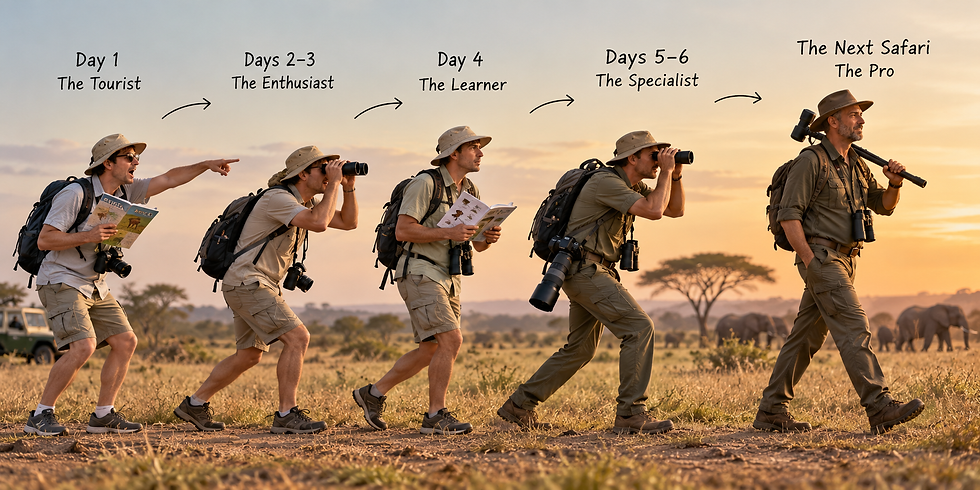
The safari guest is a remarkably adaptable creature. Given a few game drives and a patient guide, we can progress from enthusiastic beginner to someone with surprisingly firm opinions in less than a week.
I include myself in this. Experience doesn't prevent the process; it merely produces more specialised varieties.
Day 1 — Everything is significant.
We request a stop for a warthog. Then another warthog. There is no reason to believe the second is any less deserving. Every distant shape needs investigating, and we take several photographs of an antelope almost entirely concealed by a bush.
At this early stage, our requirements are modest: wildlife. Any wildlife. Please stop.
Days 2–3 — Rapid adaptation.
The antelope have names now. We recognise an alarm call and turn towards the guide for confirmation—discreetly. Words such as “territorial” enter our conversation. Something explained to us at breakfast is repeated over dinner with the quiet authority of someone who has known it for years.
Our knowledge is growing. Our confidence is growing slightly faster.
Day 4 — Natural selection.
Not of the wildlife; of our photographic opportunities. The zebra are lovely, but the background is busy. We are pleased to find the lions, although we would welcome some indication of their plans for the morning.
Binoculars are still raised, but no longer automatically. We have developed a preliminary assessment stage: what is it, what is it doing, and is the light any good?
Days 5–6 — Specialisation.
“We're happy with anything,” we tell our guide. There follows a fairly detailed explanation of the particular anything we have in mind.
An animal mentioned briefly three evenings ago has become a personal ambition. We consult the field guide over lunch. We ask about suitable habitat. We are beginning to suspect that a slightly earlier departure might improve our chances.
The next safari—and the next—A distinct subspecies.
These preferences become more refined. Some of us now plan entire trips around a small nocturnal mammal. Others can spend an hour examining one distant bird.
The declaration “I'm not really interested in birds” survives in old correspondence, but is no longer supported by our behaviour.
Our luggage contains better binoculars and a list.
Then something unexpected appears, and all that carefully accumulated expertise momentarily deserts us. Names escape us, cameras become tangled in binocular straps and our confident directions deteriorate into “There! Behind the... no, the other one!”
And just like that, we're back where we started, pointing excitedly into a bush and relying on the guide to make sense of what we're looking at.
Perhaps that's one of the nicest things about spending time in the wild. However many safaris we've enjoyed, there's always something we haven't seen, something we didn't know, or a familiar animal doing something completely unexpected. The more we learn, the more we realise how much there still is to discover. And thankfully, there are always people who know a great deal more than we do.
We might become more selective, acquire better equipment and develop increasingly obscure interests, but none of that makes the excitement of a new encounter any less genuine.
